Free Delivery & Return
 365-Day Returns
 10 Million Happy Customers
 500,000 Products in Stock

How to choose a garden parasol: size, type and base weight
Reviewed by the Beliani Content Team · Updated November 2026
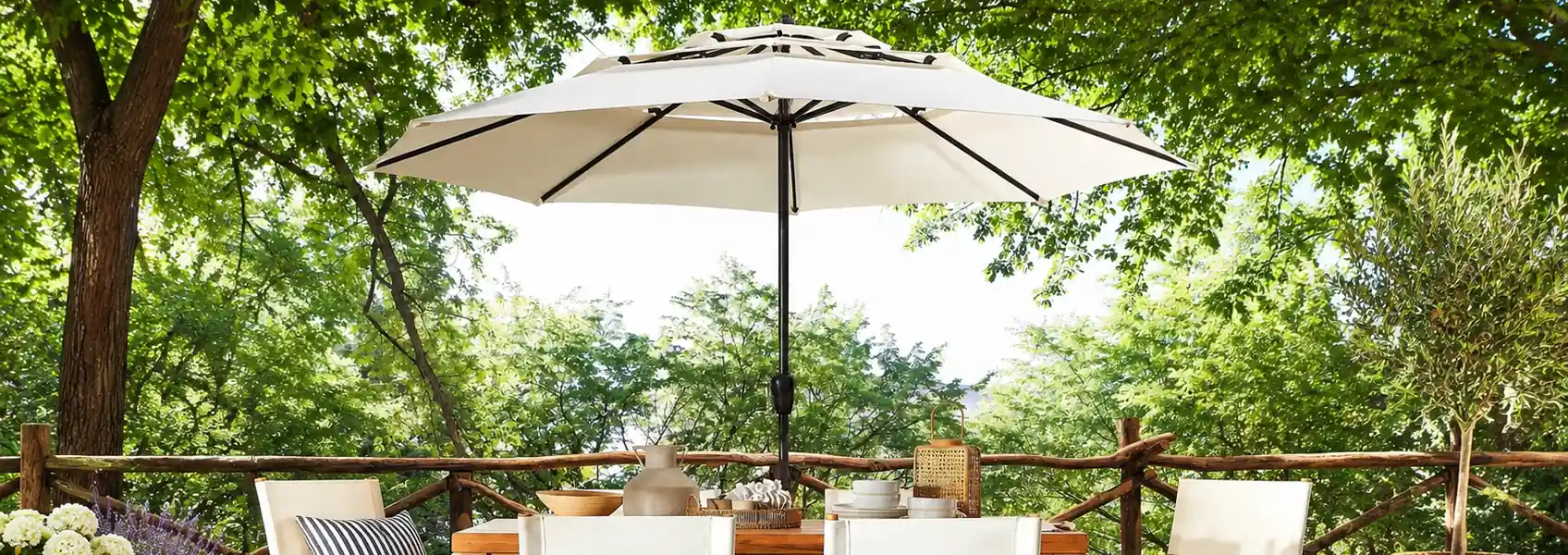
A garden parasol provides shade for outdoor dining, relaxing and spending time outside on sunny days. Choosing the right size, pole position and base helps you make the most of your outdoor space without restricting access to your furniture. This guide explains how to compare garden parasols and which specifications to check before buying.
In short
What size and type of garden parasol do you need?
Choose a canopy that covers your furniture and the surrounding seating area, including chairs when they are pulled out. As a starting point, consider a 2–2.5 m parasol for a small bistro set, around 3 m for a four- to six-seat dining set, or a larger round or rectangular canopy for more spacious seating arrangements. Choose a centre pole parasol for compact dining areas or a cantilever parasol if you want to keep the space beneath the canopy clear. Always check the required base weight, available opening clearance and model-specific wind restrictions before buying.
- Seating area: measure the space occupied by your furniture and the people using it.
- Pole position: decide whether the pole should sit through a table, beside the furniture or away from the seating area.
- Outdoor conditions: consider sun direction, wind exposure and the available space for the base.
Centre pole or cantilever: which type suits your space?
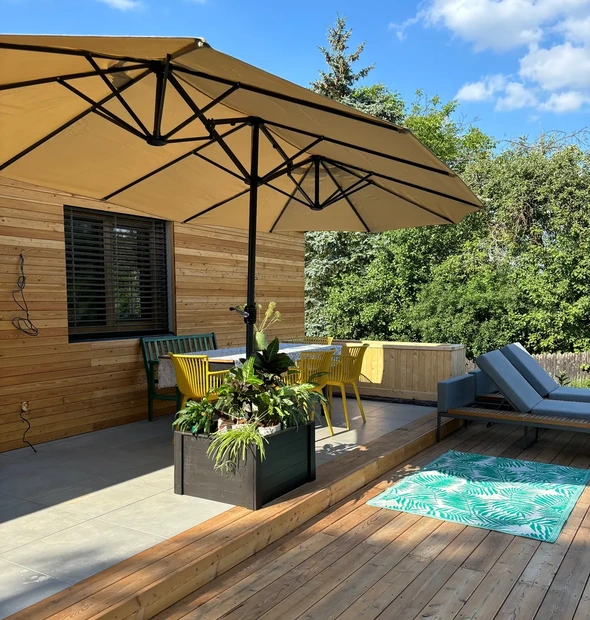
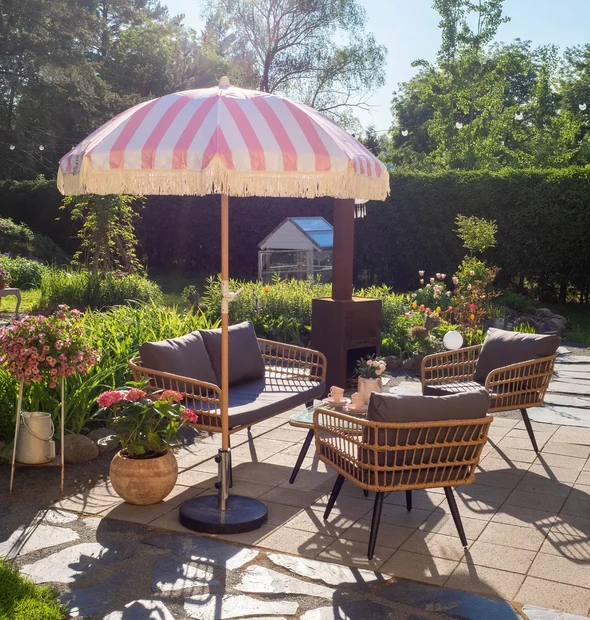
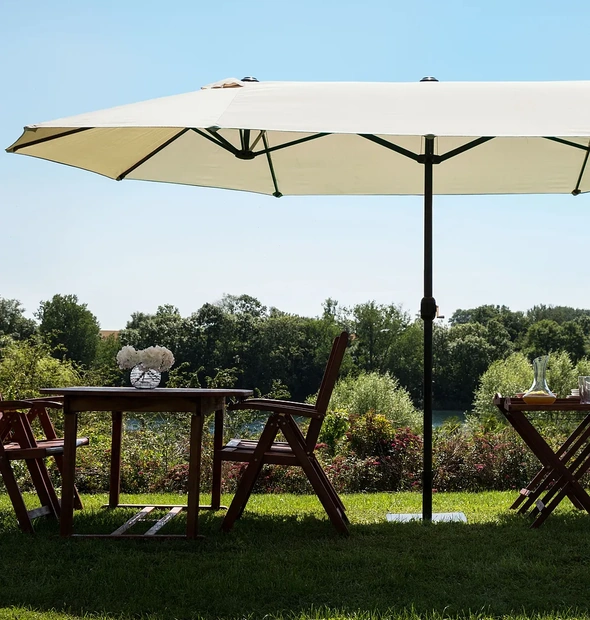
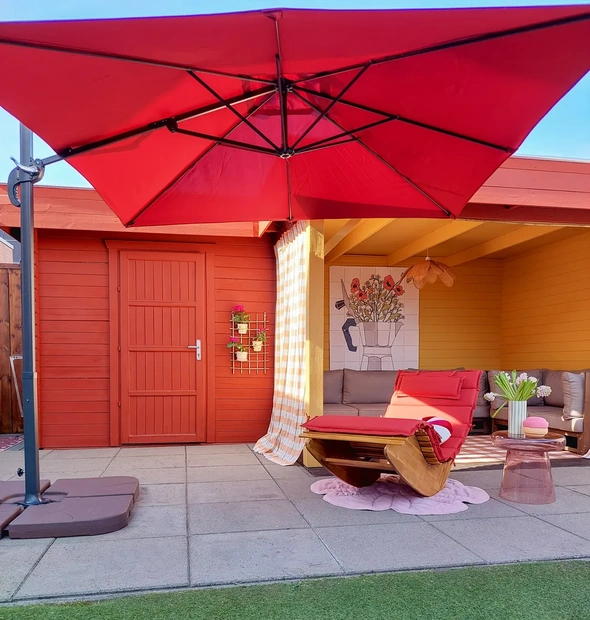
A centre pole parasol, also known as a market parasol, supports the canopy on a central pole that can pass through a garden dining table or stand beside the furniture. It is a practical choice for dining sets, compact patios and smaller gardens. A cantilever parasol, also called an offset or hanging parasol, suspends the canopy from a side arm, leaving the seating area underneath unobstructed. It is particularly useful for outdoor sofas, sun loungers and larger terraces. However, its offset design generally requires a heavier base and more space for installation. For narrow balconies or terraces, a half parasol with a compatible base can provide shade while fitting close to a wall.
| Centre pole parasol | Cantilever parasol | |
|---|---|---|
| Where the pole sits | In the centre, often through the table | To one side, with the canopy suspended from an arm |
| Best for | Dining tables, balconies and small patios | Lounge seating, sun loungers and larger terraces |
| Adjusting the shade | Tilt mechanism on selected models | Tilt and rotation on selected models for more flexible shade coverage |
| Base requirements | Generally requires less ballast than a comparable cantilever model | Typically requires substantial ballast or a manufacturer-approved mounting system |
| Main advantage | Compact design that works well with garden dining tables | Clear, unobstructed space beneath the canopy |
| Main limitation | The central pole may restrict furniture placement | The heavier base takes up more space and can be difficult to reposition |
Shop now: market parasols and cantilever parasols
How do you measure for the right canopy size?
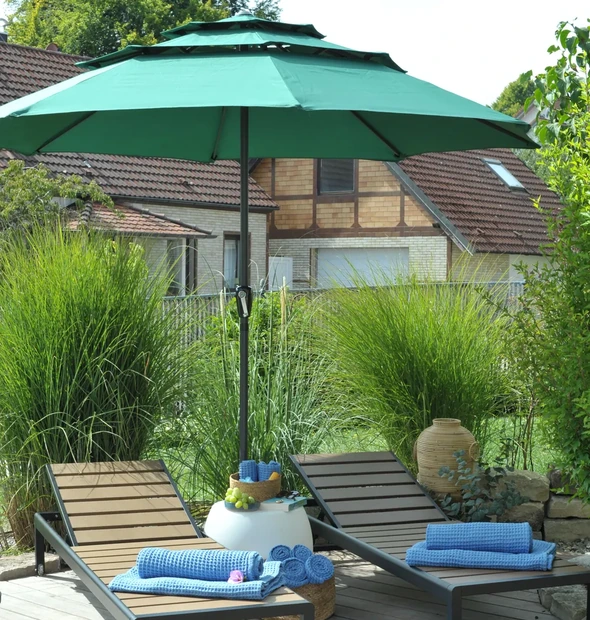
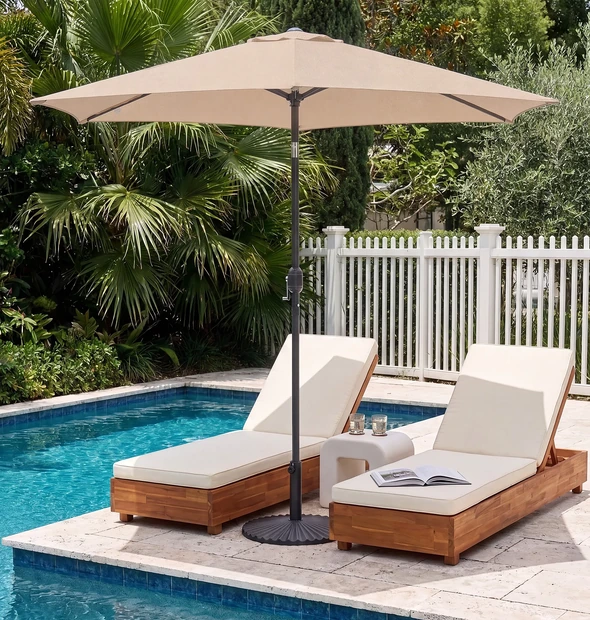
Measure both the furniture and the space around it so the canopy can shade the people using it, not just the furniture itself. A round canopy often works well with a round or square dining table, while a rectangular canopy is generally better suited to a long dining table or an extended lounge arrangement. Remember that the shaded area shifts as the sun moves. If you mainly use your garden in the morning or late afternoon, a tilting or rotating canopy may be more useful than simply choosing a larger parasol.
Measure the area you want shaded
Measure the full seating area, including the chairs when they are pulled out or the entire length of your sun loungers. Use these dimensions rather than measuring the tabletop or furniture alone.
Choose a canopy with sufficient coverage
Use the occupied seating area as your target. For example, if a 160 × 90 cm table and its chairs occupy 240 × 180 cm, a 3 × 2 m rectangular canopy is a useful starting point. Check the direction of sunlight and allow extra coverage where space permits.
Check the result against the space
Check the canopy's opening clearance, height and base footprint. Make sure you can open and close the parasol without moving furniture. Allow room for walkways, walls, railings and branches, and for the canopy to tilt or rotate if applicable.
How heavy does the parasol base need to be?
The required parasol base weight depends on the canopy size, pole position and construction of the parasol. Cantilever models generally require more ballast than centre pole models because their offset arm creates greater leverage on the base. The weight ranges below are illustrative examples, not universal safety requirements. Always follow the minimum weight and mounting instructions for your chosen model. Before ordering, check whether the parasol includes a weighted base, an unweighted cross-shaped stand or no base at all. If weights are sold separately, make sure they are compatible with the stand and provide the required total ballast.
Through a table
15 kg to 25 kg
A compatible dining table may provide additional support, but it does not replace a suitable base. Use this weight range only if permitted by the parasol manufacturer.
Free-standing centre pole
30 kg to 50 kg
A free-standing parasol relies on its base for support. Check the required ballast, pole diameter and fastening mechanism. Larger models may require a heavier base.
Cantilever
80 kg and above
Many cantilever models require substantial ballast due to their offset design. Use the specified cross base, compatible weight plates or approved mounting system for your model.
Fillable bases are easier to transport and store when empty. Check whether the manufacturer specifies sand, water or another filling material, as the final weight varies depending on the filling. Make sure the filled base meets the required ballast and that its dimensions do not obstruct chair legs, walkways or access to your furniture.
No base makes a parasol windproof
A heavy base and a ventilated canopy do not make a parasol safe to use in strong winds. Follow the manufacturer's wind limits, close the canopy before strong winds or gusts develop, and never leave it open unattended. If your outdoor space is exposed to frequent gusts, consider how easily you can close and secure the parasol between uses.
Shop now: parasol bases
Which canopy fabric gives the best sun protection?
Look for a canopy with a stated ultraviolet protection factor (UPF). A fabric rated UPF 50+ allows approximately 2% or less of UV radiation to pass through under test conditions. Polyester is a common, affordable option for everyday use, while solution-dyed acrylic is often chosen for its colour retention and outdoor durability. When comparing fabrics, prioritise the stated UPF rating over colour or thickness alone. Consider water resistance as well: a water-repellent canopy may shed light showers but is not necessarily waterproof. Check the product specifications for both UV protection and water resistance, and close the parasol during heavy rain or storms. Remember that shade does not eliminate exposure to reflected or scattered UV radiation.
Which parasol frame material should you choose?
Aluminium is a practical choice for everyday use, particularly if you frequently reposition or store your parasol, as it is lightweight and naturally resistant to corrosion. Steel is a sturdy and often affordable alternative, although damage to its protective coating can lead to corrosion. Wooden poles work well with garden furniture made from natural materials but may require periodic maintenance depending on their finish. When comparing frame materials, consider their weight, maintenance requirements and exposure to moisture. If you intend to store the parasol indoors over winter, check its closed dimensions and whether the pole can be dismantled for easier storage.
Which parasol features are worth paying for?
Prioritise features according to how often you use your outdoor space and whether you need to adjust the shade throughout the day. Opening and adjustment mechanisms are particularly useful on larger parasols, while simpler models may be sufficient for occasional use in compact spaces.
- Crank handle: makes opening and closing a large canopy easier, particularly when the parasol is used frequently.
- Tilt mechanism: angles the canopy to provide shade when the sun is lower in the morning or late afternoon.
- Rotation mechanism: allows the canopy on selected cantilever models to turn around the pole, reducing the need to reposition furniture as the sun moves.
- Adjustable height: allows you to adapt the canopy position to your seating arrangement on compatible models.
- Wind vent: allows airflow through the canopy and may reduce wind pressure, but does not make the parasol windproof.
- Integrated LED lights: provide additional lighting for evening use on selected models. Check the power source and charging requirements.
- Protective cover: helps protect a clean, dry, closed canopy from dirt and weather exposure between uses.
What to check before buying a garden parasol
Before placing your order, check the following points to make sure the parasol suits your furniture, available space and intended use.
- Measure the occupied seating area and choose a canopy size and shape that provide sufficient coverage.
- Check the pole position, pole diameter and compatibility with your garden table, if applicable.
- Confirm the manufacturer's minimum base weight and whether the base or weight plates are included.
- Measure the base footprint and check that it will not obstruct furniture, walkways or access to your seating area.
- Check the stated UPF rating, water resistance and wind restrictions.
- Confirm that the canopy can open, close, tilt or rotate without hitting nearby furniture, walls or railings.
- Check the closed dimensions, storage requirements and availability of a compatible protective cover.
Frequently asked questions
Can you leave a garden parasol outside all year?
If the manufacturer permits outdoor storage, keep the parasol closed and protected with a suitable cover when not in use. Store it in a dry, sheltered place over winter where possible. Make sure the canopy is completely dry before covering or storing it to help prevent mildew.
How do you clean a parasol canopy?
Follow the canopy's care instructions. Brush away loose dirt, then use a soft cloth or brush with lukewarm water and mild soap if permitted. Rinse and allow the canopy to dry completely in calm conditions. Avoid bleach and pressure washers unless explicitly approved.
Will a parasol pole fit through any garden table?
No. Check the pole diameter against the table opening and the compatible base fitting. Some tables include reducer rings for smaller poles. The pole should fit securely without excessive movement.
What does the vent at the top of a parasol canopy do?
A vent allows air to pass through the canopy and may help reduce pressure on the fabric and frame. It does not make a parasol safe to use in strong winds.
How can you shade a balcony without taking up too much floor space?
A half parasol with a compatible compact base can fit close to a wall. A small clamp-mounted parasol may also save floor space if the mounting point is suitable and the building permits it. Check balcony load limits, mounting instructions and wind exposure. Never reduce the required base weight simply to save space or assume a railing is suitable for a clamp.